What it really earns
Measured on an RTX 5070 Ti, not taken from a calculator.
| Coin | Algorithm | Hashrate here | Earns/day |
|---|---|---|---|
| Ergo | Autolykos2 | 242 MH/s | ~$0.38 |
| Ravencoin | KawPow | 49 MH/s | ~$0.30 |
Two coins, both worth mining. Prices move and the app recalculates all of this live, from your card's actual hashrate rather than a calculator.
Running any of this probably loses money. A card drawing 200 W costs about $0.72 a day at $0.15/kWh. Even the better option here roughly halves that rather than beating it, and the worse one is not close.
The app shows you exactly this while it runs. One tile subtracts your power cost from your earnings and turns red when you are behind — with your wattage and your electricity price, not our guesses. We would rather show you a red number than let you find out in a month.
So why run it? Because the machine is already on and often idle, and some people would rather that time accumulate a little of something than nothing at all — a bet on the coin, not on the mining. That is a real reason. It is not profit, and we won't dress it up as one.
What every setting does
None of them are hidden, and none of them lie.
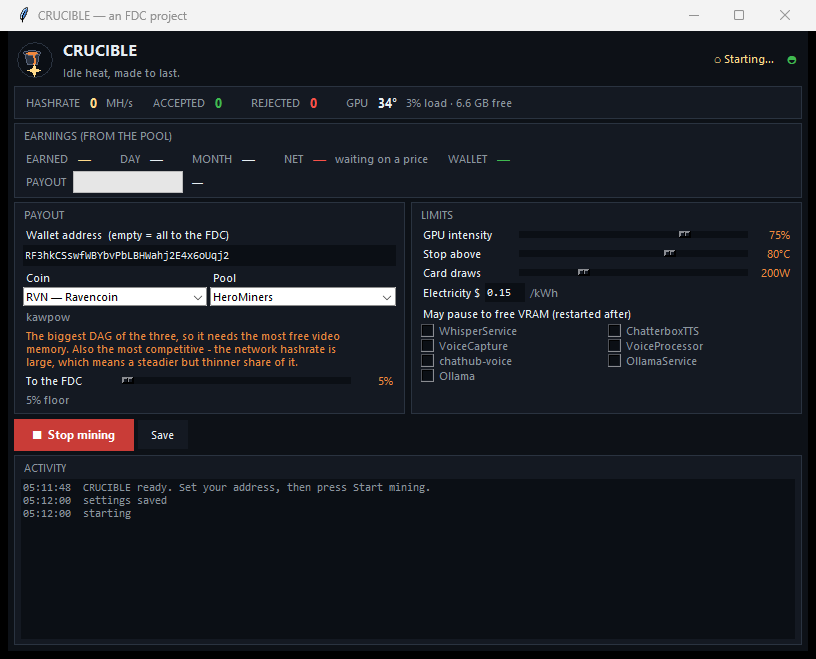
- Your wallet address
- Where your share is paid. The pool pays it directly — the money never passes through us, so there is nothing of yours for us to hold, forward, or lose. Leave it empty and everything mines to the FDC.
- Coin
- Ergo or Ravencoin — one address per chain, and they are not interchangeable. Each is mined by a kernel CRUCIBLE ships and compiles itself: no second program to install, nothing downloaded when you press start, and no developer fee taken out of your hashrate.
- Pool
- Each coin lists the pools that work with it. A pool keeps a small fee and sets a minimum before it will pay out, and balances do not move between pools — switching starts you again from zero at the new one.
- Supporting the FDC
- How much of the time mines to us instead of you. Starts at 5%. You can raise it as high as 100% — you cannot set it to zero, because that 5% is the entire price of the tool.
- GPU intensity
- 5–100%. A duty cycle: at 25% the miner works a quarter of the time and stands down the rest, so the machine stays responsive for whatever it is actually for. It means the same thing on both coins, and lower intensity earns proportionally less.
- Stop above
- A temperature ceiling. Mining pauses when the card reaches it and only resumes once it is 10 °C cooler, so it can't flap on and off at the threshold.
- May pause to free video memory
- Ergo's dataset is about 7 GB and Ravencoin's about 5.8 GB, both growing with block height, so on a busy machine there may not be room. Tick which services CRUCIBLE is allowed to stop to make space — nothing is stopped that you have not ticked, each one is recorded to disk before it is stopped, and everything is started again when mining ends, including after a crash.
Card wattage and your electricity price also live in the Limits panel. They change nothing about mining — they only make the "after power" figure yours instead of our guess.
Getting started
| 1 | Download and run CRUCIBLE.exe. There is
nothing to install and no account to make. |
|---|---|
| 2 | Pick your coin, then paste an address for that chain — a Ravencoin address is not an Ergo one. If you don't have a wallet, make one with the coin's own official wallet; it takes a minute and the keys stay yours. Leaving it blank mines everything to the FDC. |
| 3 | Set your limits: intensity, heat ceiling, spare video memory. Then press Save settings. |
| 4 | Press Start mining. Hashing begins a few seconds in rather than instantly — both coins build a multi-gigabyte dataset on the card first. That is normal. |
| 5 | Watch the Activity log. share ACCEPTED means
the pool credited you. Your balance climbs from the first one. |
Your antivirus may flag any mining program on sight, honest ones included — that is simply what the category looks like from the outside. The full source is published so you never have to take our word for anything here.
When you actually get paid
Pools don't send coin every time you earn some — the transaction fee would eat it. They hold your balance until it clears a minimum, then pay out on their own schedule. Both of ours pay hourly:
| Coin | Minimum | Worth | First payout in |
|---|---|---|---|
| Ravencoin | 5 RVN | ~$0.02 | about 90 minutes |
| Ergo | 0.5 ERG | ~$0.11 | about 7 hours |
Those minimums come from the pools themselves, and the app shows a progress bar toward yours with a live estimate — so you can tell the difference between slow and broken without guessing.
Built in the open
Both mining cores are modified copies of published source: Autolykos2_NV_Miner (MIT) and kawpowminer (GPL-3.0). Those licences carry forward, so our changes stay open and every one is written down rather than summarised.
Nothing is downloaded at runtime and no third-party miner is bundled. Every core is compiled from that source and ships inside the application — an auto-downloader would be the vulnerability, not the feature, and a closed binary would mean paying someone else a slice of your hashrate.
Fixing them was part of the work. Upstream's Autolykos2 allocates its dataset with 32-bit arithmetic, which overflows past roughly 134 million elements — a threshold Ergo crossed in 2025. Two separate places needed 64-bit maths before the miner would produce a valid share at all. The KawPow core had a subtler version of the same trap: it verifies its own results against a library, and two different projects publish that library under the same name with the same functions. Build against the wrong one and everything appears to work while every share is quietly thrown away.
We also had to build pieces that did not exist. The stock Ergo miner speaks its chain's full-node protocol, not stratum, which is why no pool documents using it — CRUCIBLE includes the translator. KawPow already speaks stratum, but a direct pool connection can only ever be one wallet, so there is a small proxy that rotates the address instead — which is how the 5% works without anything ever passing through us.